
In short
Planning decides what work needs doing and prepares it. Scheduling decides when, and with whom. Two roles do both jobs better than one.
Control the backlog by its ready work: hold enough prepared jobs that the crews never run out, and treat a backlog that is mostly unplanned as a sign that planning is behind.
Planning and scheduling only work as well as the CMMS master data: the asset hierarchy, task lists linked to bills of materials, and failure codes.
Pardus builds the asset hierarchy, task lists and work management process that planners rely on.Asset hierarchy and CMMS master data
Maintenance planning and scheduling are two jobs and are done best by two roles. Planning decides what has to be done and prepares the job. Scheduling decides when it will be done and who will do it. When one person does both under pressure, scheduling wins every time, the preparation is skipped, and the backlog fills with jobs that cannot be started.
This article covers the work management process, what a planner and a scheduler each produce, the rules and data that make the system work, and the measures that show whether it does.
The work management process
Every job passes through six steps, and each has an owner.
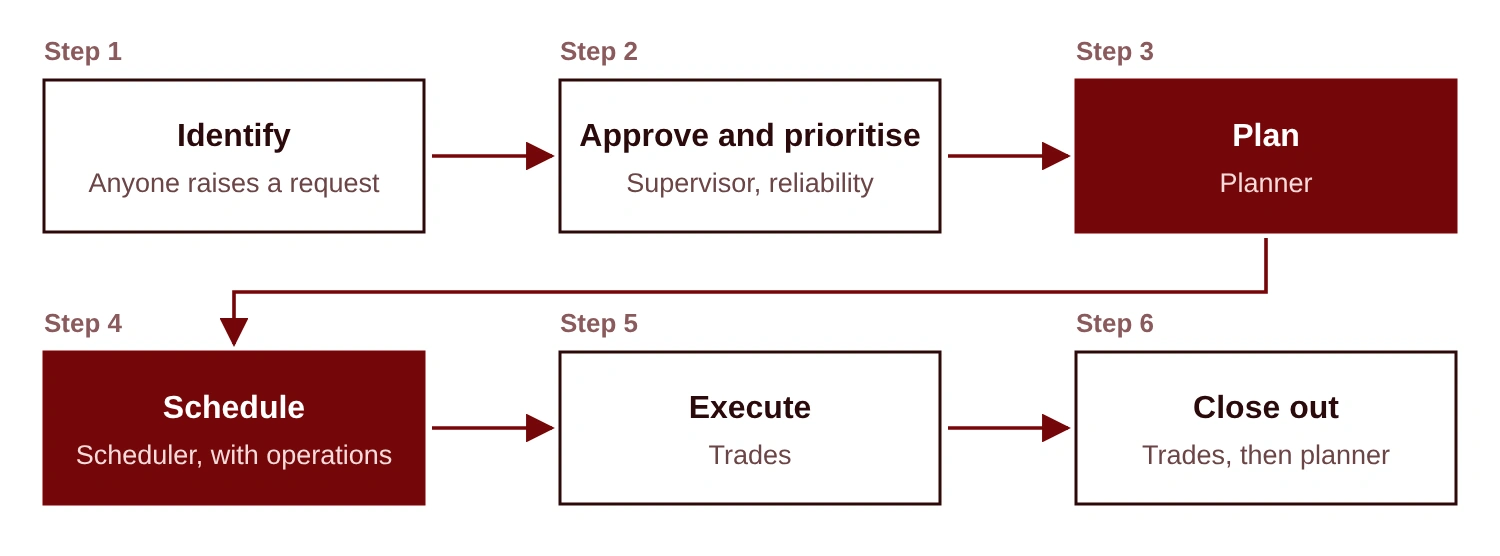
- Identify. Anyone raises a work request, against the right asset, with the symptom described.
- Approve and prioritise. A supervisor, with reliability input, checks the request, sets the priority and decides whether to do it.
- Plan. The planner prepares the job.
- Schedule. The scheduler fits ready jobs to crews and the plant, with operations.
- Execute. The trades do the work, to the plan.
- Close out. The trades record what was done, the time taken, and the failure and cause codes. The planner reviews the record and corrects the job plan if it was wrong.
The two highlighted steps are where most plants lose time, and they are the two that get merged.
Planning: what and how
A planner takes an approved work request and prepares the job so that it can be done without delay once a crew starts. A planned job states:
- the scope and the steps, with a duration for each;
- the trades and the number of people;
- the parts and materials, reserved against the work order and in the store or kitted;
- the special tools, lifting equipment and access, such as scaffold or a crane;
- the permits and isolations;
- the state the plant has to be in, running or stopped, and for how long;
- the acceptance check at the end.
A planner works on jobs days or weeks ahead of the crews. The output is a work order that is ready to schedule. Published ratios run from about one planner for 10 to 15 tradespeople, where the work is mostly corrective and needs detailed plans, to one for 20 to 30 where much of it is routine preventive work.
Most of a plant’s work repeats. Recurring jobs should come from stored job plans, which the maintenance strategy generates. Each one is a task list with its steps, durations and bill of materials, and the planner checks it against the current job and does not rebuild it. Estimates are in standard hours, and the close-out record shows when the estimate was wrong, so the job plan can be corrected for the next time.
What “ready to schedule” means
A job is ready only when all of the following are true. Without them it is planned on paper and cannot be started.
- The job plan is complete and has been reviewed.
- Parts and materials are in stock or on a kit, not on order.
- Permits and isolations are identified and can be arranged.
- Access equipment, lifting and any contractor are booked.
- The plant window the job needs exists, and operations has agreed to it.
Parts are the commonest reason a planned job is not ready. A planner who finds that a part is not in stock should find out whether a substitute exists and what the lead time is, and should not release the job until the part is due.
Scheduling: when and who
A scheduler takes the ready jobs and fits them to the resources and the plant. The inputs are job priority, crew availability, production windows and shutdown dates. The outputs are a weekly schedule agreed with operations and frozen before the week starts, and a record at the end of the week of how much of it was completed.
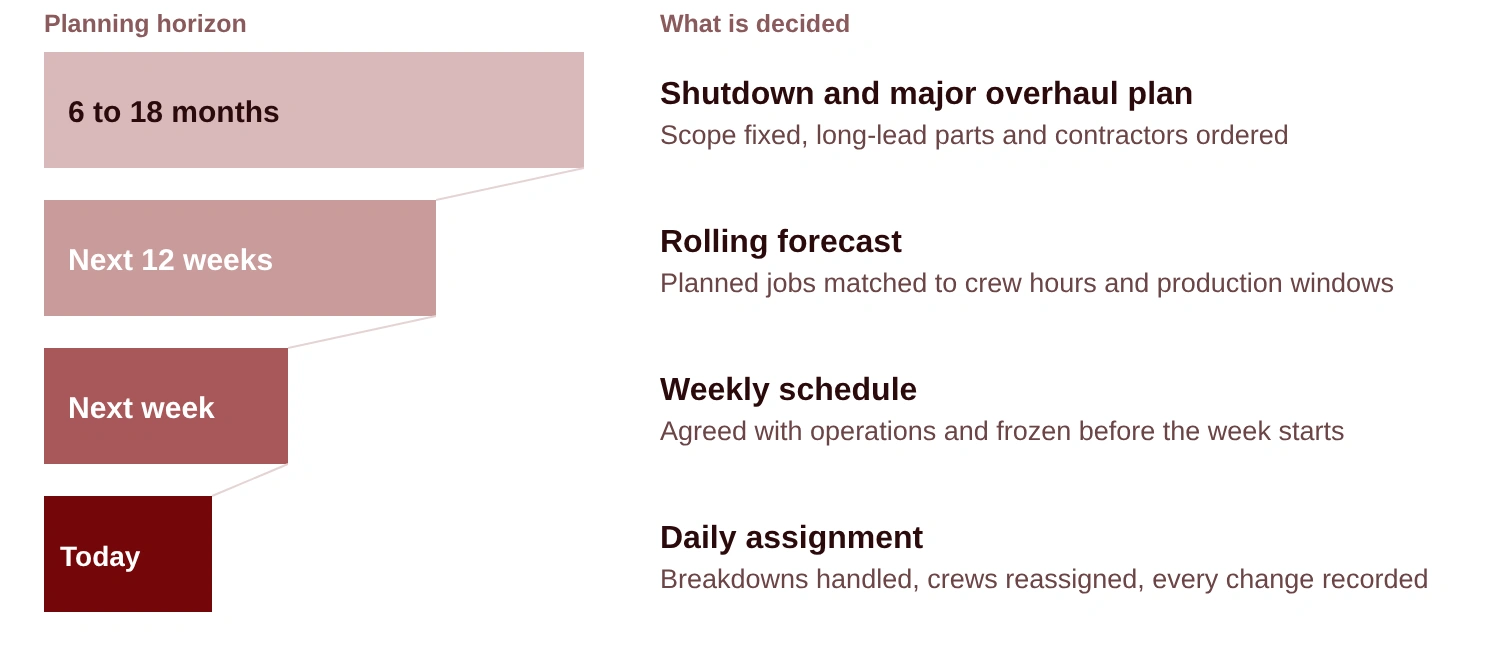
The horizons overlap, and each has a different job. Shutdown planning fixes the scope and orders long-lead parts and contractors months ahead. The rolling forecast matches planned jobs to crew hours and production windows for the next 12 weeks. The weekly schedule is agreed with operations and frozen before the week begins. The daily assignment is where the supervisor handles breakdowns and moves crews, and every change is recorded so that the next week’s schedule can be built on what actually happened.
A worked week
Take a crew of 8 fitters on 38 hours a week, which is 304 hours. After leave, training and meetings take 15%, 258 hours are available. Reactive work over the last quarter averaged 22% of hours, so the scheduler reserves 20% for breakdowns and break-ins and schedules 258 × 0.8, about 206 hours of planned jobs.
At the end of the week, 175 of the 206 scheduled hours were completed. Reactive work took 83 hours, which is 32% of the week and well over the 20% reserved. Thirty-one hours of scheduled work rolled over.
- Schedule compliance by hours is 175 ÷ 206 = 85%.
- Reactive share is 83 ÷ 258 = 32%.
The numbers say more than the compliance figure alone. An 85% compliance looks acceptable. A reactive share of 32% against a plan of 20% says the plan for breakdowns is too low, or the plant is breaking down more than it did last quarter. Either way it is a question for the next weekly meeting, and it is visible only because the scheduler reserved a figure and measured against it.
Break-ins and the frozen schedule
A frozen schedule does not mean nothing changes. A priority 1 job can break in, but by a rule. The supervisor and the scheduler agree to it, the job it displaces is named and rescheduled, and the change is recorded with the reason. Over a quarter that record shows whether the allowance for breakdowns is right, and which assets are producing the break-ins.
Controlling the backlog
The backlog is every open work order. It is measured in weeks of work, which is the planned hours divided by the hours the crews have available. The useful split is by status: ready to schedule, waiting for parts, waiting for a shutdown, and not yet planned.
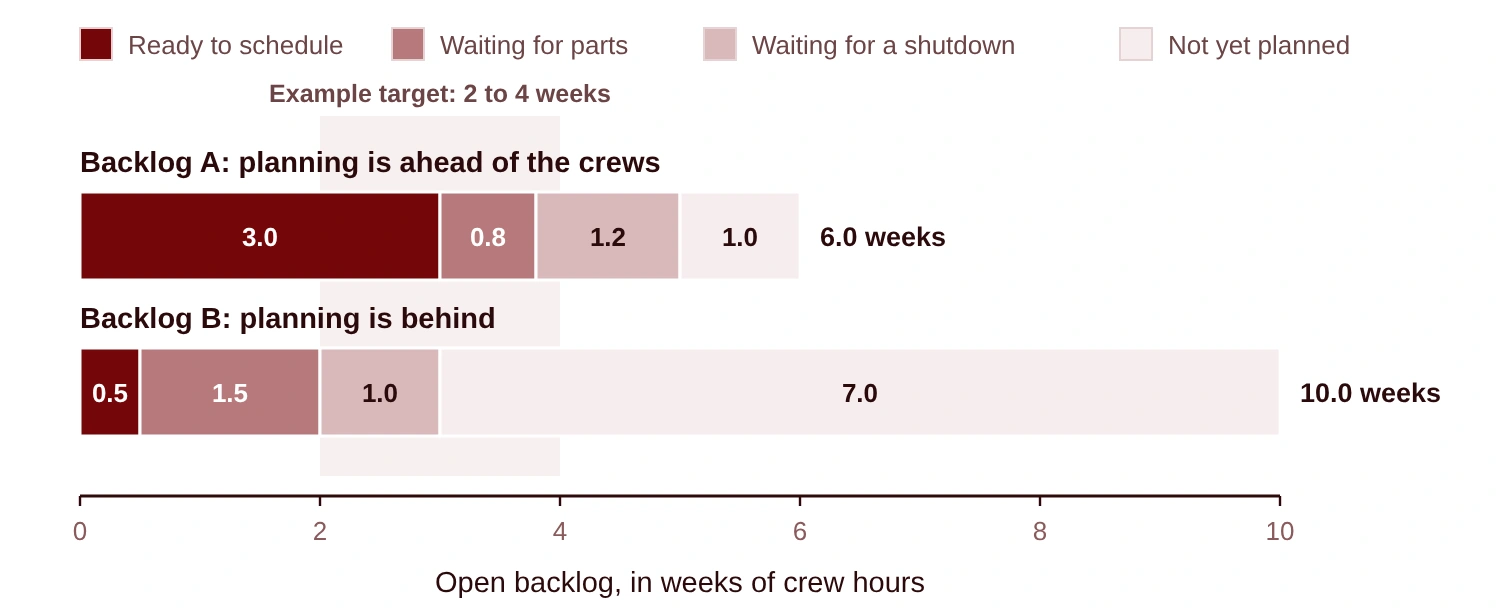
At 258 available hours a week, backlog A is about 1,550 hours. Three weeks of it is ready to schedule, inside the 2 to 4 week target used in this example. Published targets for ready work range from at least one week to several, so a site should set its own from the time its planners need to prepare jobs and from its parts lead times. At 3 weeks the crews will not run out of prepared work, and the planner is ahead of them.
Backlog B is longer, but length is not the problem. Only half a week is ready, so within three or four days the crews are out of prepared work and are put on unprepared jobs or on whatever has just broken. Seven weeks of the backlog has no job plan. That points at a planner who is behind, or who is being used for something else. The fix is to protect the planner’s time and to work the unplanned jobs in priority order.
Priority rules
The backlog needs a priority scale so it is ordered by the same logic every time. Base it on the consequence of the failure and the time available before it happens, and tie it to the criticality of the asset.
| Priority | Meaning | Response |
|---|---|---|
| 1 | Safety or environmental risk, or an immediate loss of production | Start now. Break into the schedule |
| 2 | Likely to cause a stop or damage within days | Schedule this week or next |
| 3 | Routine corrective work, no near-term effect | Plan and schedule within 6 weeks |
| 4 | Improvement or low-consequence work | Plan within 12 weeks, or hold |
The scale fails when too much work sits in priority 1 and 2. If a large share of the backlog is marked urgent, the requesters have learned that it is the only way to get work done, and the planner and scheduler cannot tell which jobs really matter. A weekly review of the priority 1 and 2 jobs, and the criticality of the asset against each, brings it back.
The data a planner relies on
Planning is only as good as the master data in the CMMS.
- The asset hierarchy. It must match the plant, so work is raised against the right asset and its history is found. A planner who has to work out which of three similar assets a request refers to loses time on every job.
- Task lists with a bill of materials. Each recurring task needs a task list, and each task list needs its parts linked. This is what lets a planner reserve parts in a minute instead of looking through manuals.
- Failure codes. A short, specific code list for the problem, the cause and the action. Without it, close-out records cannot be used to improve the plan, or to find the repeat failures that justify a root cause analysis.
- Criticality. Ranked criticality for each asset, which drives the priority and decides where the planner’s time goes first.
A planner who must rebuild this data job by job is doing data entry, and the preparation of the work is what suffers.
When one person does both jobs
On a small site the planner and the scheduler are often one person. Keep the two functions apart in time. Plan in the first part of the week, for jobs two to four weeks out. Schedule on a fixed day, for the following week, and hold the weekly meeting on that day even when a breakdown is under way. If the same hours go to firefighting every week, the planning stops, and the ready backlog shows it within a month.
Measures
Measure a small set and read them together.
- Schedule compliance. The share of scheduled hours or jobs completed in the week. Define it once and keep the definition.
- Reactive share. Reactive hours as a share of total hours. Compare it with the figure reserved in the schedule.
- Ready backlog. Weeks of ready-to-schedule work, against the target set for the site.
- Planned work share. The share of hours spent on planned and scheduled jobs.
- Planning accuracy. The estimated hours against the actual hours on the close-out, by job type. It tells the planner which job plans need correcting.
Where the maintenance strategy fits
The maintenance strategy generates the recurring work: the tasks, frequencies, trades and durations. If the strategy is loaded to the CMMS as task lists, planning starts from a prepared library, and the planner reviews and adjusts it. If it is not, the planner builds each job from scratch and the quality varies from one planner and one job to the next. The failure mode analysis that produces the strategy is described in the FMEA vs FMECA article, and the tasks it produces are what the planners and schedulers work from every week.
Miguel Pengel, RPEQ (Mechanical) 28380, is the principal engineer at Pardus Consulting and the author of Reliability Engineering for Heavy Industry. About Pardus.