
Reliability engineering training for mining and heavy industry
Two to five days on site: Weibull analysis, maintenance intervals, spares, life-cycle cost, RCM, condition monitoring and jack-knife diagrams, worked on your own failure data. More than 1,000 engineers have been trained.
- Engineers trained
- 1,000+
- Length
- 2 to 5 days, at your site
- Content
- 8 modules, worked on your own failure data
- Price
- By written proposal
Engineers from mining, oil and gas, power, aluminium and heavy equipment companies have trained with Pardus.
Who it is for
Reliability and maintenance engineers, planners, asset managers, maintenance superintendents, condition monitoring analysts, plant and process engineers, and graduates, in mining and mineral processing, oil and gas, power, manufacturing, water, and ports and bulk handling. There are no prerequisites; a working knowledge of Excel helps.
Where: your mine, plant, workshop or office, in Australia or overseas. When: dates set with you, for groups of five or more.
What your team can do the week after
- Fit a Weibull distribution to their own failure data and read what it says. Weibull calculator
- Set a maintenance interval from cost and reliability, and defend it to management. Maintenance interval calculator
- Size critical spares for a target service level. Critical spares calculator
- Rank downtime into chronic and acute failures with a jack-knife diagram. Jack-knife diagram
The eight modules
| Module | What it covers | Template you keep |
|---|---|---|
| 1. Foundations | Why equipment fails, the bathtub curve, MTBF, MTTR, availability, failure rate and the reliability function | |
| 2. Weibull analysis | Shape and scale, plotting and fitting failure data from heavy industry | Weibull analysis |
| 3. Optimal maintenance intervals | Failure risk against maintenance cost; intervals for your own equipment | Optimal maintenance interval |
| 4. Spares | Holdings from failure rate, lead time and acceptable risk; holding cost against production risk | Spares calculation |
| 5. Life-cycle cost | Replacement timing; repair, refurbish or replace; Monte Carlo simulation of the uncertainty | Life-cycle cost model, Monte Carlo simulation |
| 6. Reliability-centred maintenance | The seven RCM questions, the decision logic, FMECA and building a PM program | |
| 7. Condition monitoring | Vibration, oil analysis and thermography; machine learning for prediction; condition monitoring inside RCM | |
| 8. Downtime prioritisation | Jack-knife diagrams from downtime data; chronic and acute losses; defect elimination | Jack-knife diagram |
How it runs. The full course is five days and covers all eight modules; a focused workshop of two or three days covers the modules you choose. Send your failure and downtime data beforehand and the exercises are built on it, so your team leaves with analyses of its own equipment. Every template is an Excel workbook the attendees keep, with no paid software.
Three ways to learn
Request a proposal
Say how many people, where, and which modules matter most. A written proposal with the price comes back within 48 hours.
Questions people ask
How many people can attend?
The course runs for groups of five or more. Each attendee works through the exercises on a laptop with your site’s data.
Do attendees need any software?
Only Excel. Every template is an Excel workbook they keep, with no paid licences.
Can the course use our own data?
Yes. Send failure and downtime data before the course and the exercises are built on it, so attendees leave with analyses of their own equipment.
Does the course count towards CPD?
Yes. Structured training counts towards the continuing professional development that Engineers Australia and the Board of Professional Engineers of Queensland require, and attendees can log the course hours.
What does it cost?
The price is per course, not per seat, and depends on the length and the location. The price is set out in a written proposal.
Who teaches it
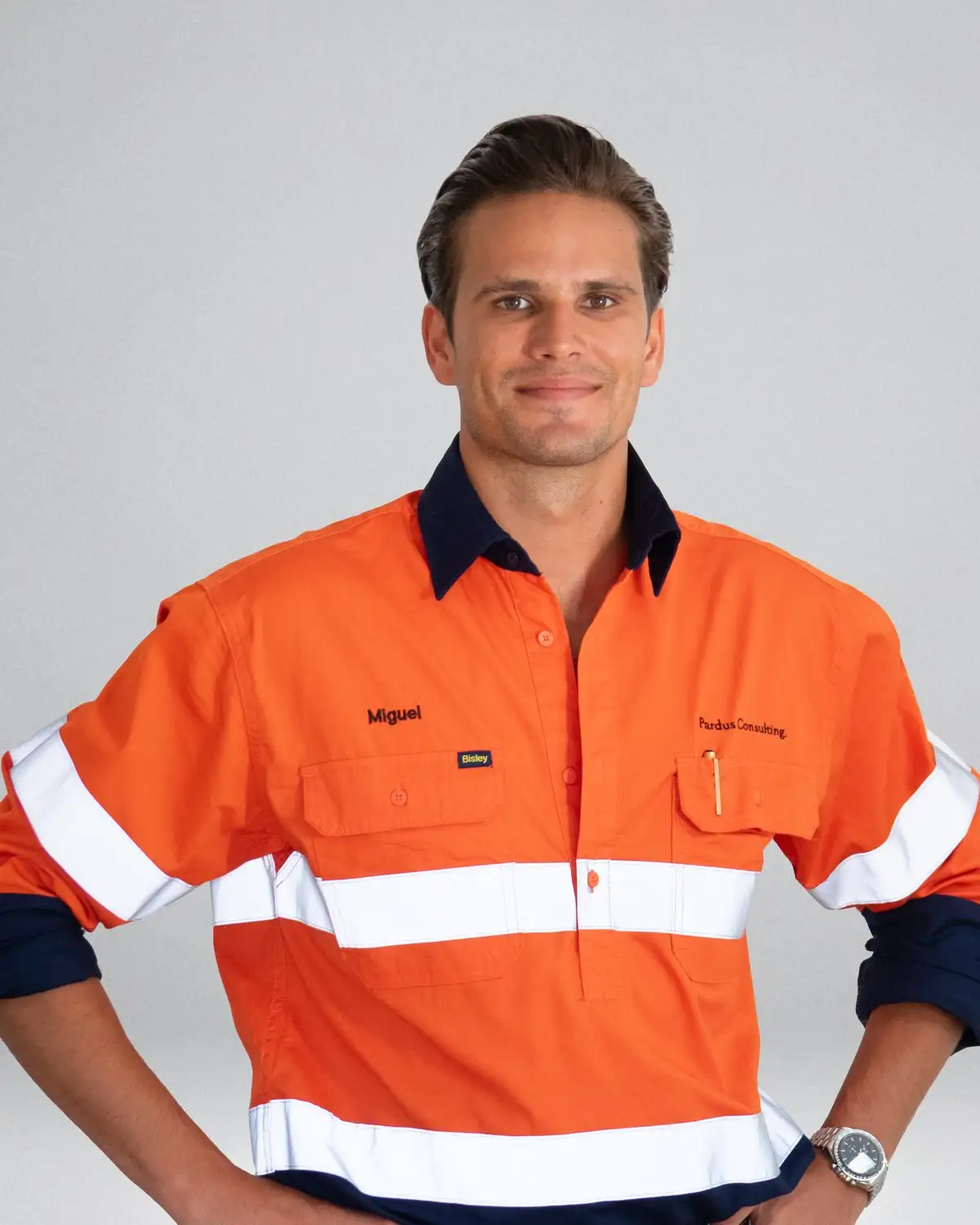
The course is taught by Miguel Pengel, RPEQ (Mechanical) 28380, Pardus's principal engineer and the author of Reliability Engineering for Heavy Industry. The examples come from the firm's own project work on mining fleets and processing plants.